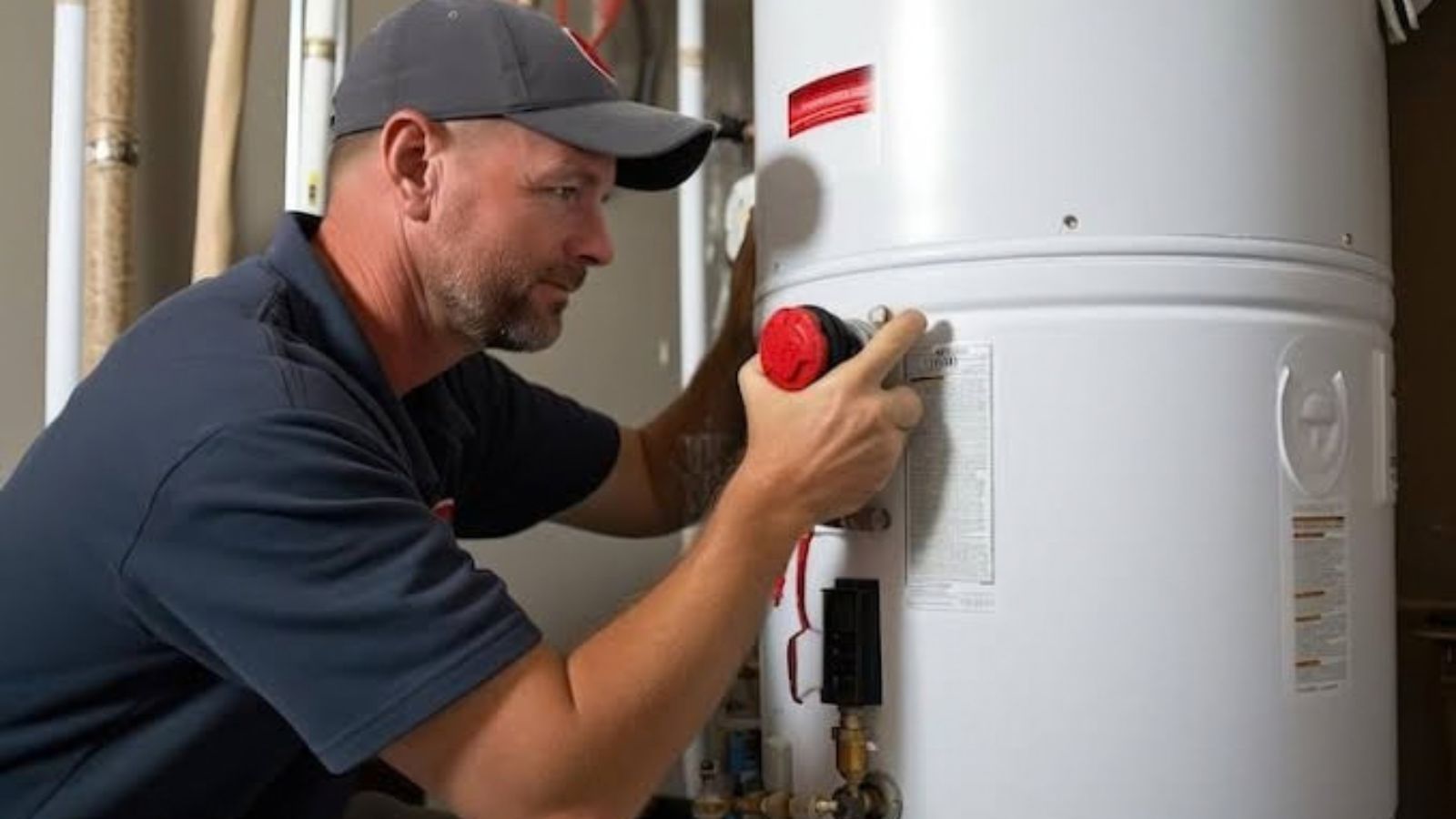
Why Water Heaters Fail Early Here
Queen Creek's water comes mainly from local groundwater wells, and it runs very hard, averaging about 12 grains per gallon. That hardness leaves mineral scale on the heating element and along the bottom of a tank, which makes the unit work harder to heat the same amount of water and shortens its working life well below the manufacturer's rated number.
Beyond water quality, we're also replacing a fair number of original builder-grade units that are simply reaching the end of their service life as Queen Creek's newer neighborhoods age past the ten-year mark. If your unit is popping, rumbling, or visibly rusted at the base, replacement is usually the more economical call than another repair.
Tank vs. Tankless: An Honest Comparison
| Standard Tank | Tankless | |
|---|---|---|
| Upfront cost | Lower | Higher |
| Hot water supply | Limited by tank size | Continuous |
| Space needed | More (closet or garage) | Wall-mounted, compact |
| Hard-water sensitivity | Moderate | Higher, needs regular descaling |
| Typical lifespan here | 8 to 10 years | 12 to 15 years, with maintenance |
Neither option is automatically right. A tankless unit needs a softener or a regular tankless descaling service to actually reach its longer rated lifespan in this water. Without that, the maintenance cost can erase the efficiency gain.
Atmospheric vs. Power-Vent: Why It Affects Your Install
Not every water heater location in a Queen Creek home can take a straightforward atmospheric-vent unit. If the heater sits in an interior closet or a spot without a clear path to the roofline, a power-vent or direct-vent model, which uses a fan to push exhaust out through a sidewall, is often the only code-compliant option.
That choice affects both the unit cost and the install time. We confirm it during the visit rather than assuming from the old unit's setup, since a prior installer may have already worked around a venting constraint you're not aware of.
On newer Queen Creek builds specifically, garage installations are common, and garages here get genuinely hot in summer, which some manufacturers factor into warranty terms for ambient temperature. We check the unit's rated operating range against the installation location before recommending a specific model.
Not sure which setup you have? Call (480) 741-9332 and we'll take a look.
What's Included
Every replacement includes removing and hauling away the old unit, bringing the install up to current code (strapping, venting, the T&P relief line), and a full leak check before we leave.
Straightforward Pricing
Every range below is a real starting point, and your exact price is written down and approved before we start.
If your current unit is under 6 years old and the problem sounds minor, it may make more sense to start with water heater repair instead. Want a real number for your specific home? Call (480) 741-9332.
Water Heaters From The Villages To Ironwood Crossing
Most homes in The Villages at Queen Creek were built in 2002 and 2003, so original tanks there are long past their rated life. A first-ever replacement is one of the most common jobs we do in that community.
In newer areas like Hastings Farms and Ironwood Crossing, we check whether the original builder-grade unit is still the right size for the household living there now. We size the replacement to your real hot water use and pull the permit through the office that covers your address.
Cold Showers Or A Leaking Tank?
We install replacements in Queen Creek, ZIP 85142 and 85140, most days same-day.
Frequently Asked Questions
A straight tank-to-tank swap is usually a same-day job, often 2 to 3 hours. A switch to tankless, or a repipe to bring an older setup up to current code, can take longer, and we'll tell you which situation you're in before starting.
Manufacturers typically rate a standard tank at 8 to 12 years, but Queen Creek's very hard groundwater accelerates the scale buildup that causes early failure, so units here often need replacement on the earlier end of that range without regular flushing.
Queen Creek enforces the 2021 International Plumbing Code (IPC) for installations, which sets requirements for venting, seismic strapping, and the temperature-and-pressure relief line. We handle the permit and inspection process as part of the installation.
Tankless units give you continuous hot water and take up less space, but they're more sensitive to scale buildup than a tank, so they need a water softener or regular professional descaling to hit their expected lifespan here. We'll walk through the honest trade-off for your household.
Yes, removal and disposal of the old water heater is included in every replacement.