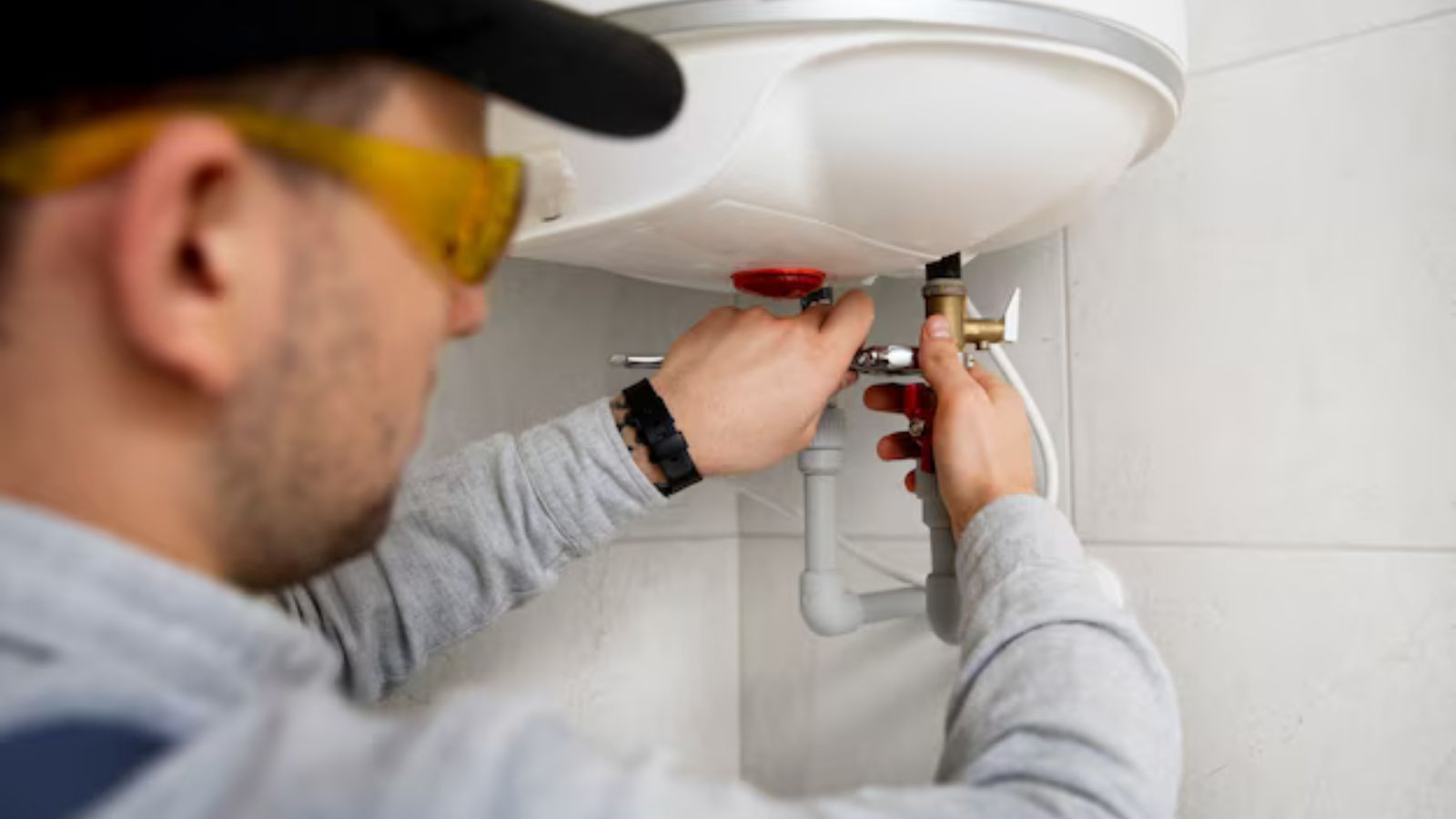
Water Heater Emergency: What To Do Before We Arrive
A leaking water heater can empty a tank onto a garage or closet floor within minutes, so the first goal is to stop the water and remove the power source. Most calls on this topic start with a puddle someone noticed late, or a heater that went cold overnight.
- 1Shut off the cold water supply valve on top of the heater. That stops the tank from refilling while it leaks.
- 2Turn off the power. Switch the breaker off for an electric unit, or turn the gas control to off for a gas unit.
- 3Stay clear of the relief valve pipe. Water from that discharge pipe can be scalding.
- 4Move boxes and stored items away from the water, then call our 24/7 line so we can arrive while the heater is still isolated.
A leak from a fitting is often a same-visit repair. Water seeping from the body of the tank usually means the tank itself has failed, and the U.S. Department of Energy lists 10 to 15 years as the typical life of a storage tank water heater. Call (480) 741-9332 and we will help you decide on the phone.
What's Actually Wrong
- 1No hot water at all usually means a failed heating element, a tripped thermostat, or, on gas units, a pilot light or igniter problem.
- 2Hot water that runs out fast often points to a bad lower heating element or sediment that's shrunk the tank's usable capacity.
- 3Popping or rumbling sounds are almost always mineral scale built up on the bottom of the tank, a very common issue given how hard Queen Creek's water runs.
- 4Rust-colored water or a leak at the base usually means the tank itself is corroding internally, which is a replacement sign more than a repair.
Seeing one of these? Call (480) 741-9332 and describe it to our dispatcher.
Diagnose First, Then A Real Price
We test the thermostat, heating elements, gas valve, or igniter as applicable, and check the tank itself for internal corrosion before quoting anything. That's the only way to know honestly whether a repair will actually hold.
Repair Or Replace?
| Situation | Usual Recommendation |
|---|---|
| Unit under 6 years, single failed part | Repair |
| Unit 8+ years, second repair in 2 years | Replace |
| Leak from the tank body itself | Replace |
| Popping/rumbling, no leak, unit under 7 years | Flush and repair |
Gas vs. Electric: Different Diagnostic Path
A gas water heater with no hot water usually traces back to a pilot light that's gone out, a faulty thermocouple, or an igniter that isn't sparking on demand-ignition models. We check the gas valve and venting as part of that diagnosis, since a venting problem can shut a unit down as a safety measure.
An electric unit instead comes down to the upper or lower heating element, the thermostat, or, less often, a tripped high-limit switch that needs manually resetting once the underlying cause is fixed.
Knowing which type you have before we arrive helps, but it isn't required. Our technicians carry parts for both gas and electric units on the truck for the most common failure points, so most repairs finish in a single visit regardless of which kind you have. On every gas unit, we test the temperature-and-pressure relief valve as standard practice before considering the repair complete, the same safety check called for under Queen Creek's adopted plumbing code.
Straightforward Pricing
Every range below is a real starting point, and your exact price is written down and approved before we start.
Most homeowners insurance covers sudden tank failure that causes water damage, but not the repair or replacement of the water heater itself. If your unit turns out to need full replacement, see water heater installation & replacement. Want your real number? Call (480) 741-9332.
Repairs In Established Streets And New Subdivisions
In communities from the early 2000s, such as Sossaman Estates, and on the streets just off Ellsworth Road, a failing thermostat or element can be a sign of a tank near the end of its life. We test before we recommend, so you are not replacing a unit that needs a single part.
Out toward Encanterra and the Ironwood Crossing area, the same symptoms can also point to scale or a tripped safety control, so we test before we say which. Either way, we tell you whether repair or replacement makes more sense for your specific unit.
No Hot Water Right Now?
Our emergency line is answered 24 hours a day, every day, anywhere in Queen Creek.
Frequently Asked Questions
It's usually mineral scale that's built up at the bottom of the tank, and it's very common with Queen Creek's hard water. It's not an emergency by itself, but it does mean the unit is working harder than it should and is worth having checked before it leads to an earlier failure.
As a rule of thumb, if the unit is under 6 years old and the repair is a single part like a heating element or thermostat, repair usually makes sense. Past 8 years, or if you're looking at a second repair within a year or two, replacement is typically the better value. We'll give you an honest read on your specific unit.
A leak at the base is almost always the tank itself failing internally from corrosion, not a fixable fitting. That's one of the clearest signs replacement is the right call rather than repair.
Yes. Tankless units in Queen Creek most often need attention because of scale buildup inside the heat exchanger from the hard local water, which we can flush, or because of an error code pointing to a specific component.
A manufacturer's warranty on the tank itself doesn't cover the labor to diagnose and fix the problem, so there's usually still a service charge even on a covered unit. We'll tell you upfront if a part looks like it may be a warranty claim.
Yes. Our emergency line is answered 24 hours a day, and we dispatch for active leaks and no hot water calls at any hour. Tell the dispatcher whether the unit is gas, electric, or tankless so the technician arrives with the right parts.